Engaged Scholar Faculty & Community Fellows Program
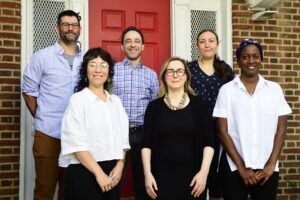
The Engaged Scholar Faculty and Community Partner Fellows Program is a cohort-based program housed at the Center for Social Concern that facilitates the development and implementation of mutually beneficial Community-Based Learning courses.
Community-Based Learning is a high-impact pedagogy that connects Faculty and Community Partners as co-educators for the purpose of prompting students to critically think about social and civic issues, while simultaneously meeting community partner/education partner-identified goals.
By encouraging a greater role for CBL at Johns Hopkins, the CSC is working to provide community members a greater voice in campus life and bridging gaps between the Homewood campus and surrounding communities.
How to Become a Faculty Fellow
The Engaged Scholar Fellows Program is an application-based program. Faculty applicants will be contacted shortly after submitting their application with next steps. Faculty applicants do not need to have a Community Partner co-educator identified by the time that their application is submitted. The Center for Social Concern can facilitate the process of connecting Faculty Fellows to Baltimore City-based Community Partner co-educator(s) as potential partners.
Application Process and Procedures
Applications are currently closed. Please check back next spring. Faculty applicants do not need to have a Community Partner co-educator identified by the time that their application is submitted. The Center for Social Concern can help introduce Faculty Fellows to potential Baltimore City-based Community Partner co-educator(s). Please contact [email protected] with any questions.
Benefits
Expertise and knowledge can be found all throughout Baltimore City. Community Partners are immersed in non-profit, community organizing, and/or civic work, and hold a wealth of knowledge and resources that can powerfully contribute to the Hopkins student experience. The Engaged Scholar Program seeks to identify community partner co-educators who have the capacity to co-develop and co-implement a community-based learning course alongside a faculty partner.
Engaged Scholar Faculty and Community Partner fellows each receive a $2,000 co-educator stipend for the year and up to $1,000 in additional funding for CBL course logistics.
In addition to funding, the Faculty Fellows also receive training and logistical support through the Center for Social Concern.
Role and Responsibilities
- Teach a community-based learning course for students in either the Krieger School of Arts and Sciences, the Whiting School of Engineering, and/or Peabody during the spring.
- Co-educate alongside a community partner Co-Educator(s). Faculty and community partner Co-Educators should design/review the course syllabus together and determine mutually agreed upon feedback and metrics for course success.
- Participate in a two-day orientation to be held during the end of Summer (mid-August).
- Attend once a month, one-hour cohort development sessions during the following months: September, October, November, February, March, and April. The date and time of these sessions will be scheduled ahead of time, with the cohort’s input.
- Complete a program evaluation offering feedback to the Assistant Director of Engaged Scholarship about the Engaged Scholars Program.
- Whenever possible, connect Co-Educators to Hopkins resources.
Engaged Scholar Faculty and Community Partner Fellows 2025-26 Cohort and Spring Courses
Baltimore’s Solidarity Ecosystem
Instructor: Valeria Procupez
Course Number: AS.070.211
Baltimore is replete with economic experimentation, organizing, and transformation. Learning from/with these experiences and contributing to them is the main aim of this course. It involves a combination of engaged service, collaborative research, reading and reflection to understand, critically engage with, and inform place-based efforts to build solidarity economies and equitable urban futures in the city. Sponsored by the JHU Center for Social Concern, the course is co-taught with community organizers from Red Emma’s workers cooperative to give first-hand exposure to economic conditions, community needs, and organizing efforts. Students will work closely together with community members in developing collaborative and interdisciplinary projects for social justice and urban regeneration. Class will meet twice a week, once on campus and once on-site at Red Emma’s in Waverly.
Listening to Baltimore
Instructor: Judah Adashi
Course Number: PY.123.532.01
This course explores the connections between listening in day-to-day life and listening as a musician, with an emphasis on the ways in which listening to the people and sounds of Baltimore can make us more engaged and responsice as composers and performers.
This class is supported in part by the JHU Center for Social Concern’s Engaged Scholar Faculty and Community Partner Fellows Program, and will be co-taught by Dr. Judah Adashi and Erricka Bridgeford, Executive Director of the Baltimore Community Mediation Center and Co-Organizer of the Baltimore Peace Movement.
Reintroduction to Writing: Medial Strategies: Communicating Science Through Games
Instructor: Jason Ludden
Course Number: PY.123.532.01
Students in this class will examine and research how medical systems and communities create and recreate networks of organ donors and recipients. Working with outreach educators and curriculum developers at the Maryland Science Center (MSC), students will learn how to explain complex STEM ideas and theories using effective lessons and projects for students and adults alike. In order to better understand the contemporary organ transplant system and the role infectious diseases may play, students will meet with medical researchers and staff. In addition to writing a research paper and accommodating scientific findings for public audience, the class will develop a boardgame to communicate the organ transplant process. As a course aligned with Center for Social Concern at JHU, we will be closely collaborating with our community partners (MSC and the John G. Bartlett Specialty Practice) to learn about communication and community building.
Incarceration, Reentry, and Personal Storytelling
Instructor: Shannon Robinson
Course Number: AS.220.213
The United States incarcerates more people than any other democratic country in the world; Baltimore City has the highest incarceration rate in Maryland, with 1 in every 100 residents locked up in a state prison. In this publicly-engaged course, students will learn about mass incarceration in the United States—its history, its dysfunction, and its current impact on the Baltimore community. In addition to reading and reflecting on personal narratives from the American Prison Writing Archive (housed at the JHU Sheridan Libraries), we will interact with organizers, activists, educators, and writers working with and on behalf of currently and formerly incarcerated people. In partnership with PIVOT Baltimore, a reentry program serving formerly incarcerated women, students will perform interviews and assist individual memoir projects.
Community- Engaged Writing: Public Health Campaigns & Information Access
Instructor: Lauren Fusilier
What counts as “public health,” and who gets to define it? This course begins by exploring the boundaries and possibilities of public health—how it is framed in institutions, how it is practiced in communities, and how writing can bridge the gap between the two. Students will examine the difference between public health as a discipline and public health as lived experience, investigating how communication shapes access, trust, and care.
Working with local nonprofits and clinics, we will identify real communication needs and create public-facing materials—such as campaigns, infographics, or revised guides—that make vital health information accessible, usable, and impactful.
This course is especially valuable for public health majors who want to move beyond quantitative methods to develop people-centered communication skills, address issues of equity and accessibility, and practice writing as a tool for public wellbeing. By the end of the semester, students will understand public health as more than a set of policies or data points—it is a network of relationships, stories, and acts of care that depend on effective, inclusive communication.
Social Impact Design, Nusaybah
Instructor: Abu- Mulaweh
Course Number: EN.660.392
How might we write the stories of neighborhoods that no longer exist? In this community-engaged writing course, students will work closely with the Baltimore City Archives to uncover the stories of people who lived in neighborhoods demolished by the Housing Authority of Baltimore City between the 1930s and 1960s. We will examine documents that the Housing Authority generated while acquiring homes for demolition— photographs, appraisal forms, court affidavits, and more—to consider the way these forms of writing impacted the lives of Baltimoreans facing displacement. In the process students will learn strategies for reading mundane, bureaucratic, and even dehumanizing sources against the grain, to find glimpses of the vibrant lives and everyday struggles of ordinary Baltimoreans. Students will critically reflect on the range of texts that they encounter and generate in their own lives as they build an awareness of the many writing decisions and rhetorical strategies they already bring to our work in the classroom. Working in a variety of modes and genres, students will write for both academic and public audiences. The course culminates with a collaboration with local archives and museums: students will research and create texts for a public exhibit on the history of Baltimore neighborhoods that have been lost to urban renewal, gentrification, and other forms of displacement.