Charting the Path Ahead: Takeaways from the 2025 FGLI Conference
By: Hoang Nguyen Ortiz
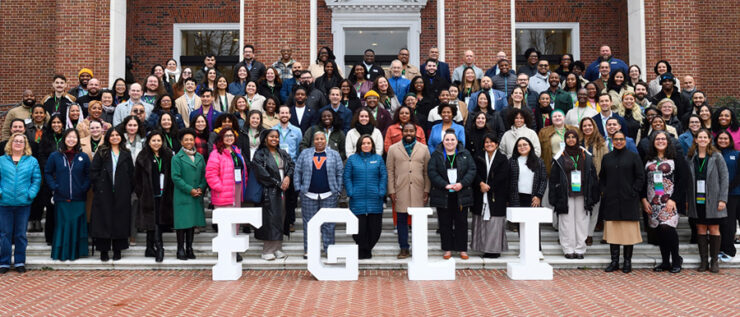
Johns Hopkins University proudly served as host of the 2025 First-Generation Limited-Income (FGLI) Consortium Annual Conference, themed “Our North Star Moment: The Promise and Challenge of FGLI Student Success in a Time of Uncertainty.” The four-day event brought together administrators, faculty, and practitioners from institutions and nonprofit organizations across the country to share promising practices, strengthen networks, and advance collective efforts to support first-generation and/or limited-income students.
“Hosting the FGLI conference at Johns Hopkins is exciting in so many ways,” said Liana C. Mentor, Senior Director of Success Coaching and Academic Advising (SCAA) and conference chair. Mentor was inspired to bring the conference to Johns Hopkins after attending a previous FGLI conference in Chicago. “To see that vision come to life, through the incredible work of colleagues and campus partners, is truly inspiring,” said Mentor. Bryan Capers, former Director of the FLI Network at Johns Hopkins and now Director for Student Transitions and Family Engagement, and Shaena Moody, Assistant Director of Community Engagement for SCAA, served as co-chairs of the conference planning committee.
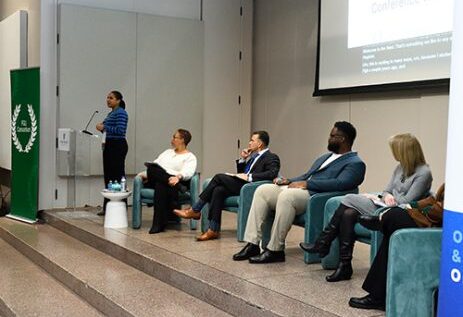
The conference opened with the keynote panel, “From Campus to Capitol: The Intersections of Policy, Politics, and Our Everyday Practice,” moderated by Jenn White, host of “1A” on WAMU. Panelists Wil Del Pilar (The Education Trust), Ernest Ezeugo (Lumina Foundation), Julie Groeninger (Princeton University), and Nina Vazquez (Connecticut Center for Leadership and Justice) examined how national policy decisions shape institutional practice and student experiences, underscoring the importance of advocacy, coalition-building, and centering lived experience.
Rashné Jehangir, founding director of the First-Gen Institute at the University of Minnesota, delivered the faculty keynote, weaving research and storytelling to explore first-generation student identity and belonging. Her remarks highlighted how first-generation students “make meaning of their academic journeys, the cultural wealth they bring, and the ways institutions can either affirm or distance them from a sense of home on campus.”
As the host institution, Johns Hopkins held its spotlight sessions on the third day of the conference, opening with remarks from Tiffany Mfume, Associate Vice Provost for Student Success and Retention Initiatives.
“It was truly an honor and privilege for Hopkins to serve as the host institution for the 2025 FGLI Conference, especially since one-third of our undergraduate student population at JHU are first-generation and/or lower-income students,” said Mfume. “This conference provided a tremendous opportunity for us to engage with our peers in the exchange of innovative, data-driven, and outcomes-oriented strategies to support and uplift FLI students and their families.”
This conference provided a tremendous opportunity for us to engage with our peers in the exchange of innovative, data-driven, and outcomes-oriented strategies to support and uplift FLI students and their families.
Following the welcome, a Johns Hopkins spotlight panel showcased initiatives across Success Coaching and Academic Advising and the FLI Network, highlighting holistic advising and coaching practices, community-building efforts, and signature programs designed to foster belonging, persistence, and student success.
Additional concurrent sessions reflected the breadth of innovation across institutions, including Hopkins-led programming on meeting basic needs with integrity, sessions from the Kessler Scholars Collaborative on leadership and network-building, Rutgers–Camden on ethical storytelling, the Aspen Institute College Excellence Program on structured student supports, and a Pivot Panel on navigating institutional change moderated by FGLI Consortium co-founder Kourtney Cockrell.
The 2025 FGLI Consortium Annual Conference concluded with participants reflecting on shared learning, strengthened partnerships, and renewed commitment to advancing first-generation and limited-income student success through collaboration, adaptability, and sustained institutional engagement.
Following the welcome, a Johns Hopkins spotlight panel showcased initiatives across Success Coaching and Academic Advising and the FLI Network, highlighting holistic advising and coaching practices, community-building efforts, and signature programs designed to foster belonging, persistence, and student success.
Additional concurrent sessions reflected the breadth of innovation across institutions, including Hopkins-led programming on meeting basic needs with integrity, sessions from the Kessler Scholars Collaborative on leadership and network-building, Rutgers–Camden on ethical storytelling, the Aspen Institute College Excellence Program on structured student supports, and a Pivot Panel on navigating institutional change moderated by FGLI Consortium co-founder Kourtney Cockrell.
The 2025 FGLI Consortium Annual Conference concluded with participants reflecting on shared learning, strengthened partnerships, and renewed commitment to advancing first-generation and limited-income student success through collaboration, adaptability, and sustained institutional engagement.